The Hidden Number Every Ecommerce Brand Should Know Before Cutting Another Ad Campaign
The campaign you are about to cut could be bringing in some of your most valuable customers. Before you pull back the budget, there is one place in your numbers you need to look.

You know the moment. One of your ad campaigns has settled at a $70 customer acquisition cost, but the maximum you believe you can afford is $60. It’s bringing in customers, but every new sale appears to be costing you too much.
So you do the responsible thing and pull the budget back before it gets worse.
Then you open the Meta Ad Library or scroll through your feed and see the same competitors still advertising. Some of their ads have been running for months. Others seem to be everywhere. And you find yourself wondering: How can they keep paying for customers I can’t afford to acquire?
If that’s you, here’s the uncomfortable part.
The problem may not be your $70 CAC. It may be the $60 ceiling you’re judging it against.
If that ceiling is based on what customers spend on their first order, or an average that blends all your customers together, it may not reflect what customers from that particular campaign go on to spend over the following weeks and months.
A campaign that looks too expensive today may be getting cut before the real value of its customers has had time to appear. And that means you could be walking away from valuable customers while your competitors continue paying to reach them.
Brand A
Cuts Based on Today’s Numbers
It judges the campaign on the first sale. The customers look too expensive, so it cuts before their full value has time to appear.
CUTS THE CAMPAIGNBrand B
Spends Based on the Full Picture
It knows what customers like these go on to spend. The $70 CAC is worth paying, so it keeps the campaign running and buys more.
KEEPS THE CAMPAIGNDoes Any of This Sound Familiar?
- You run one maximum CAC across products whose customers repeat at very different rates.
- A campaign gets cut before the customers it brought in have had time to place a second or third order.
- Subscription buyers and one-time buyers sit inside the same blended average.
- Two channels look identical in week one, and nobody checks whether their customers behave differently by day 30, 60 or 90.
- The LTV figure behind your CAC target was set months ago, before your offer mix, refund rate and customer behavior changed.
- The number in the dashboard is technically correct, and it still does not answer the decision in front of you.
If more than one of those resonates, the constraint may not be your media buying. It may be the information available when the decision gets made. At this level of spend, choosing whether to hold or push a budget is a real bet with real money. You want more certainty than one blended number can give you.
Your Business Does Not Have One LTV
Your ad platform tells you what it costs to acquire a customer. Your sales data records what that customer bought afterward. But these numbers are rarely brought together in a way that shows how much customers from each source spend over time.
The first order still matters. It affects cash flow, payback and how much working capital you need to fund growth. But it is only the beginning of the customer’s value.
One customer comes back for the same product, starts a subscription or buys something else. Another customer, acquired for exactly the same amount, never buys again or eventually requests a refund. Blend all of those customers together and you get one neat LTV figure.
But that average can hide the difference that matters most.
Say your average customer value is $150.
Customers acquired through one funnel might reach $220 over time, while customers from another stall at $95. If you judge both funnels using the same average and the same CAC ceiling, you risk overspending on the weaker customers while cutting the stronger ones too soon.
So the real question is not simply, “What is our LTV?”
It is:
What are the customers acquired through this particular product, funnel, channel or affiliate actually worth, and how much can we afford to pay for more of them?
This Is Exactly What the LTV Review Was Created to Show You
A free LTV Review takes your historical sales data and shows what customers from each product, funnel, channel or affiliate have actually gone on to spend over time.
Instead of giving you one blended LTV figure, it shows how customer value builds day by day, where different groups begin to separate, and the revenue-based CAC ceiling supported by each segment.
That means you can see whether a campaign that looks expensive on the first order is genuinely costing you too much, or whether it is bringing in customers whose value only becomes clear later.
- See how customer value builds day by day after the first purchase
- Compare customers from different products, funnels, channels and affiliates
- Account for repeat orders, subscriptions, backend revenue and the timing of refunds
- See the revenue-based CAC ceiling that each segment’s value supports
What Makes This Different From Another LTV Estimate
Most ecommerce brands rely on one of two LTV figures:
- A single average across all their customers
- A projection of what those customers might spend in the future
The problem with both is simple.
One hides important differences by blending every customer together. The other tries to predict what will happen using assumptions that are often wrong. Ultimately, neither shows you, day by day, what customers from each product, funnel or traffic source have actually gone on to spend.
This is where an LTV Review is different.
It works from realized historical customer revenue.
It tracks the revenue each customer generated over time:
- Their initial purchase
- Repeat orders
- Subscription payments
- Backend revenue
- Refunds, deducted when they occur
Then it groups those customers by product, funnel, channel, affiliate or cohort and shows how much revenue each segment has generated over time so you can see which campaigns are bringing in your most valuable customers and get the confidence you need to scale.
See How Customer Value Changes Over Time
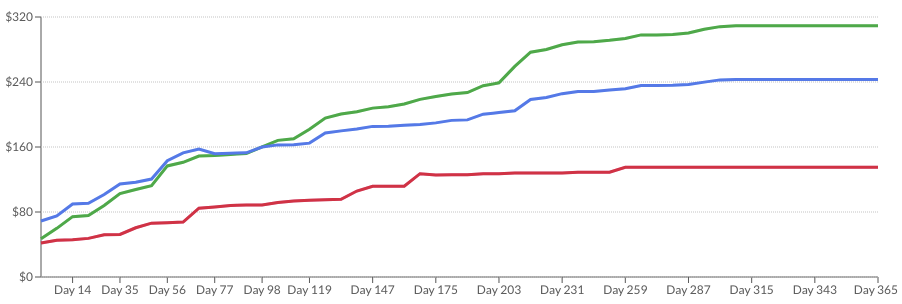
Notice how customer value continues to build after the first purchase. The chart shows how much more revenue came in over time, and how long it took for that growth to begin slowing down. A first-order view cannot show any of this yet.
See Which Customers Are Actually Worth More
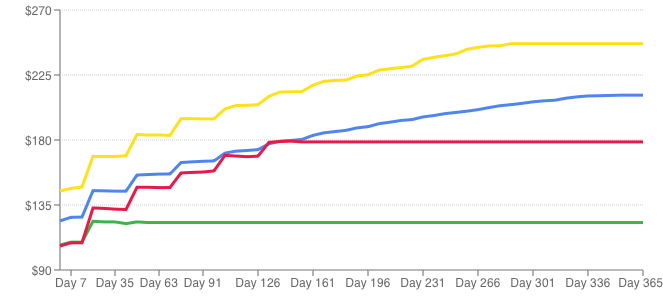
A blended average would combine these customers into one curve and hide the differences between the segments. Separated, those differences are the point. One group may support a higher CAC than your blended number allows. Another may not.
Know Which Campaigns Deserve More Time
Run this across your acquisition and you may uncover one of three things.
- A segment whose customers repeat and subscribe may support a higher CAC ceiling than your blended figure suggested. A campaign you were about to cut may be worth keeping and testing further.
- A segment that looked healthy inside the blended average may support a lower ceiling, because its customers return less often or refund more. That is a reason to spend less there, not more.
- If your current target already matches how those customers behave, the analysis confirms it and gives you greater confidence in the decisions you make from it.
In practice, that can change which campaigns you give more time, which ones you cut and which ones deserve more budget. It does not tell you to spend more everywhere. It tells you where spending more is supported by what your customers have actually done.
Built to Read Customer Value From Your Own Data
LTV Numbers was founded by Tyler Ryan, a former NASA software engineer, to help businesses measure customer value from their own transaction history instead of relying on estimates.
What Brands Who Use LTV Numbers Are Saying
“The platform has allowed us to start comparing the value of various traffic from affiliates, podcasters and ad platforms. That has allowed us to scale up spending in areas that are working, and slow down or stop spending on traffic sources that aren’t profitable.”
“We set our CPA for paid ads and customize affiliate commissions based on day 30, 60, and 90 LTV, allowing us to focus on the highest leverage channels and scale aggressively on both fronts.”
“Knowing how much you can spend to acquire a customer is everything. LTV Numbers showed us our winning audience-ad combination. We then went from spending $100 / day in the negative to spending $5,000 / day within a week.”
What Happens During Your LTV Review
We map your customer revenue over time by product, funnel, channel, affiliate and cohort, then walk through the findings together: how quickly value builds, where a blended average has been hiding a difference that matters, and the real CAC ceiling each segment supports.
You leave the call knowing what customers from each segment have been worth over time and the revenue-based CAC ceiling each one supports, whether or not you continue with LTV Numbers.
How the LTV Review Compares
| Capability | The LTV Review | First-Order Reporting | Blended LTV | Projected LTV |
|---|---|---|---|---|
| Shows revenue after the first order | Yes | No | Yes | Estimated |
| Separates value by product, funnel, channel or affiliate | Yes | No | No | Varies |
| Shows how customer value builds day by day | Yes | No | No | Estimated |
| Includes repeat orders, subscriptions, backend revenue and refunds | Yes | No | Varies | Varies |
| Gives you a revenue-based CAC ceiling for each customer group | Yes | No | No | Varies |
The LTV Review shows you which campaigns are bringing in your most valuable customers and how much you can afford to pay for more of them so you can scale your offers with confidence.
Get your customer-value curve and the revenue-based CAC ceiling supported by each product, funnel, channel or affiliate.
Book My Free LTV Review →Common Questions
If you are spending more than $5,000 a day on paid acquisition, then yes. LTV Numbers works with a range of ecommerce businesses, as well as information, coaching, membership and subscription businesses. The Review is especially valuable when customers can buy again, subscribe, purchase through different offers or enter through several acquisition sources.
Attribution can tell you where a sale came from. The LTV Review shows what customers from that source went on to spend over time. That means you can compare the real value of customers from different products, funnels, channels and affiliates, then see the revenue-based CAC ceiling each group supports.
No. Instead of estimating what your customers might be worth in the future, the Review analyzes what they have actually spent over time, including repeat orders, subscriptions, backend revenue and refunds. This gives you real evidence from your own customers to guide your CAC decisions.
Because the best way to show you the value of LTV Numbers is to analyze your own sales data and let you see the findings for yourself. Some businesses decide they want this information available every day and continue working with us. Others do not. Either way, you leave the Review knowing what customers from each segment have been worth and the revenue-based CAC ceiling their value supports.
Stop Guessing What You Can Afford to Pay for a Customer
Get your customer-value curve and see the revenue-based CAC ceiling supported by each product, funnel, channel or affiliate.
Book Your Free LTV Review →No software to install · No login to share · Your data is deleted after the call